GPT-6.2 Astra and Sol Are Out, and Astra's API Price Drops 20%
Astra gets cheaper per token and better at slides and site design, Sol keeps its price, and the API docs carry two pricing catches.


OpenAI released GPT-6.2 on 17 November in two versions: Astra for your hardest projects, and the cheaper Sol for your everyday work.
Both are live now in ChatGPT Work, Codex and the API.
Astra’s input and output token prices are 20% lower than GPT-6 Astra’s, says OpenAI’s GPT-6.2 announcement, and your plan decides what you get.
Build sites with AI? Then this one’s aimed at you.
OpenAI says Astra builds frontends that look and work better, “particularly for websites, gaming, and 3D design”.
What GPT-6.2 Astra and Sol change
Astra is still OpenAI’s pick for your hardest projects. Its pitch this time is slides, spreadsheets and documents that follow your own templates and read less like AI.
So the useful bit for marketers is decks. 9to5Mac reports that Astra can use a screenshot of one slide as the template, then match its layout, colours and font size.
In existing codebases, OpenAI says Astra is better at making and testing changes.
Sol is the other half.
My guess is it’s the one most of you will use day to day. Then come the vendor charts, all from OpenAI:
- FrontierCode 2.0 (Cognition’s test): Sol came within half a point of Astra at about one-fifth of the cost, with both at maximum reasoning.
- Agents’ Last Exam: Astra scored 5.5 points ahead of Anthropic’s Claude Fable 5.2, at 5% of the cost.
Those are OpenAI’s numbers from tests it chose to publish, so I’d treat them as a reason to try GPT-6.2 on your own work and not as proof that it beats the model you use today.
Who gets it, and what it costs
Sol’s API price doesn’t change, and OpenAI calls the new Sol “smarter, more efficient” than GPT-6.1 Sol.
The Verge frames the release as an update to OpenAI’s two most powerful models. Here’s how access splits, per OpenAI:
- ChatGPT Work and Codex: Plus, Pro, Enterprise and Edu. If you’re on Enterprise or Edu, you wait for your workspace admin to switch it on.
- Ultrafast: both models on Pro 500. Pro 200 gets it for the first time, starting with Sol.
- API: Astra at $8 per million input tokens and $40 per million output tokens, Sol at $2 and $10.
9to5Mac adds that Ultrafast can generate tokens at up to 4.5 times the standard speed. It eats more of your allowance, though.
Running a lot of repeat prompts? OpenAI’s tip: keep the start of each prompt unchanged and add new instructions at the end, so more of it bills at the cached rate.
What we checked
On 18 November I read OpenAI’s API model pages for GPT-6.2 Astra, GPT-6.2 Sol and the older GPT-6 Astra, to check the prices and limits the announcement doesn’t spell out.
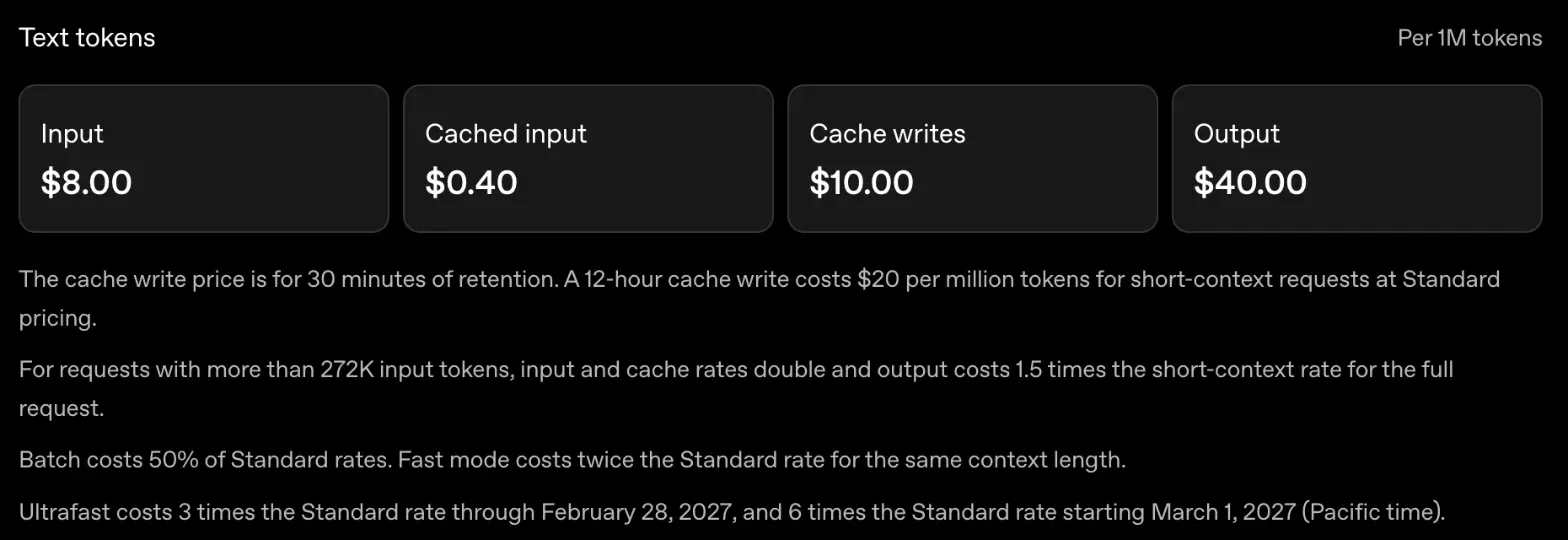
The 20% holds. GPT-6 Astra is listed at $10 per million input tokens and $50 per million output tokens, against $8 and $40 now.
Cached input falls further, from $1.00 to $0.40 per million tokens.
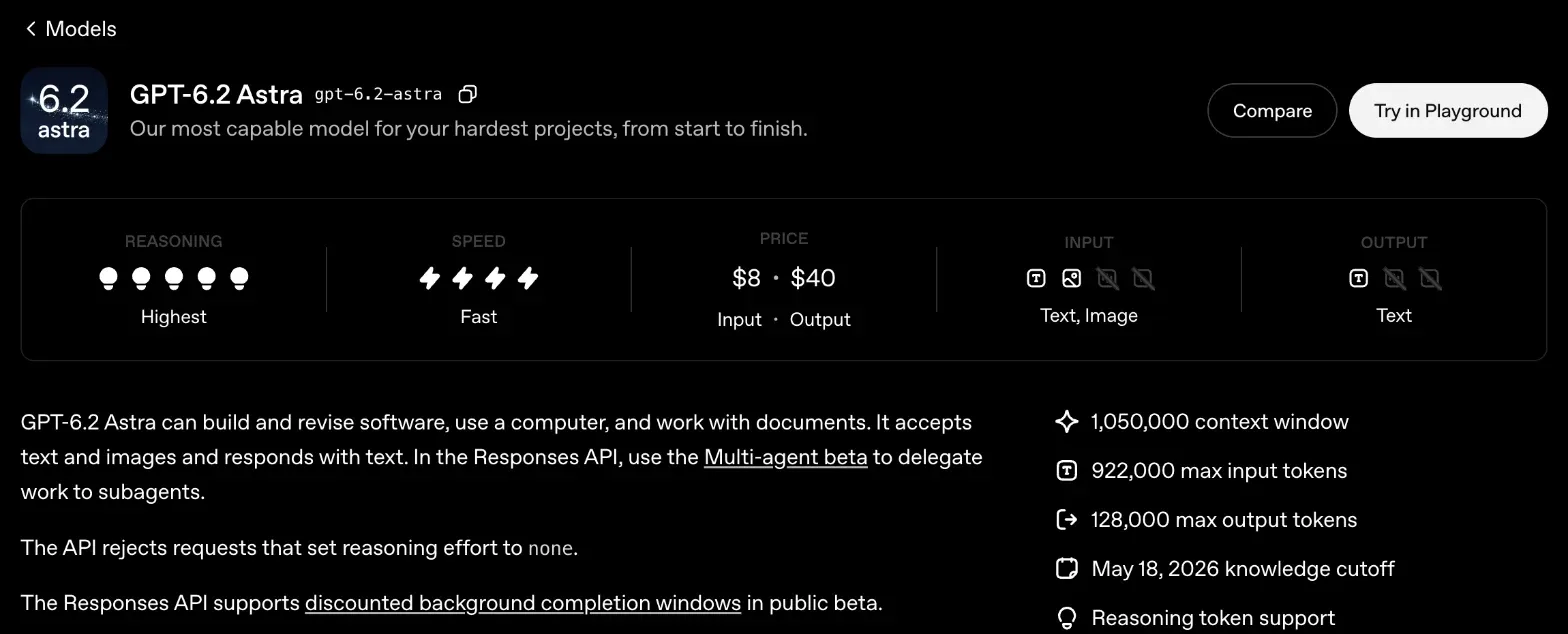
Both new models list a 1,050,000-token context window and 128,000 max output tokens. Astra’s knowledge cutoff is 18 May 2026, Sol’s 1 June 2026.
The announcement skips two catches. Above 272K input tokens, your input and cache rates double, and output costs 1.5 times as much for the whole request.
And Ultrafast costs 3 times the Standard rate through 28 February 2027, then 6 times from 1 March, on both models.
Why it matters
On Plus or Pro, you don’t need to do anything. The models are there now.
Still, I’d run Sol on one real job you already know well, like a landing page you built last month or a client deck you’ve sent, before you trust any chart.
For API users, the cheaper Astra changes the maths, but that long-context surcharge bites if you feed it whole sites, long exports or a year of Search Console data in one go.
So if you’re on the API:
- Keep your big inputs under 272K tokens where you can.
- Budget for Ultrafast doubling in price on 1 March.
There’s one more line I’d read twice.
In two of OpenAI’s tests, both models were more likely to leave out obstacles that blocked their work, like a missing file. OpenAI added Codex instructions to cut that down.
My take: check what an agent says it did, every time, more so now that ChatGPT and Codex will share one allowance.
OpenAI also says Astra is its first externally released model to meet the High threshold for AI self-improvement, and both ship with tighter cybersecurity safeguards.
Testing your own sites for holes? Expect more refusals.
That said, GPT-6.2 lands three weeks after GPT-6.1 Terra at half the price of Sol. Is Astra cheap enough now to be your default?
Common Questions
When was GPT-6.2 released and who can use it?
OpenAI released GPT-6.2 Astra and GPT-6.2 Sol on 17 November 2026. They’re in ChatGPT Work and Codex for Plus, Pro, Enterprise and Edu users, and in the OpenAI API as gpt-6.2-astra and gpt-6.2-sol.
How much does the GPT-6.2 Astra API cost compared with GPT-6 Astra?
GPT-6.2 Astra costs $8 per million input tokens and $40 per million output tokens, 20% less than GPT-6 Astra’s $10 and $50. Cached input drops from $1.00 to $0.40 per million tokens.
Is GPT-6.2 Sol more expensive than GPT-6.1 Sol?
No. GPT-6.2 Sol keeps GPT-6.1 Sol’s API prices of $2 per million input tokens and $10 per million output tokens, with cached input at $0.10.
Sources
- Introducing GPT-6.2 Astra and SolOpenAI (opens in a new tab)
- OpenAI releases its updated GPT-6.2 Astra model.The Verge (opens in a new tab)
- OpenAI upgrades ChatGPT and Codex with new GPT-6.2 Astra and Sol models9to5Mac (opens in a new tab)
- GPT-6.2 Astra ModelOpenAI API docs (opens in a new tab)
- GPT-6.2 Sol ModelOpenAI API docs (opens in a new tab)
- GPT-6 Astra ModelOpenAI API docs (opens in a new tab)


